


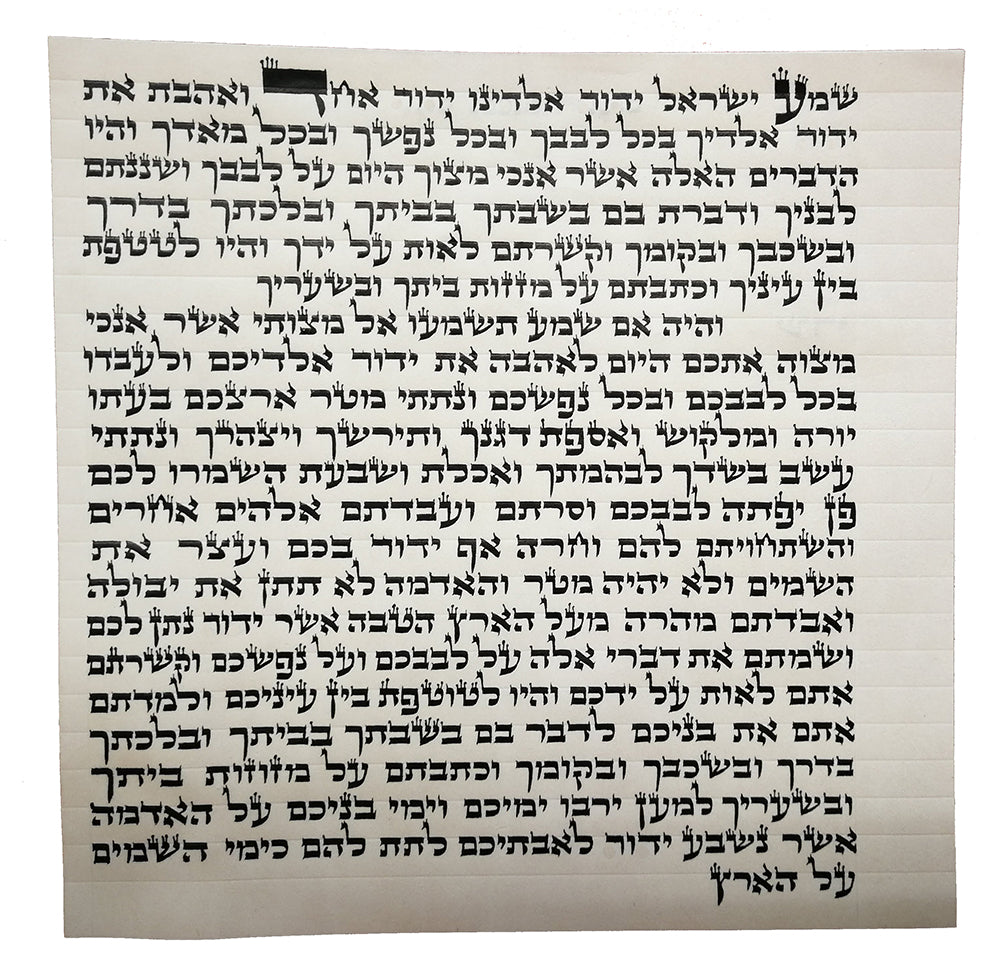
The Scroll: The Heart and Soul of the Mezuzah
When we picture a mezuzah, we usually think of the case on the doorpost. Inside it rests the part that makes the mitzvah possible: a handwritten mezuzah scroll. The case gives the parchment a protective, dignified home; the sacred words written within are the heart and soul of the mezuzah.
The many styles of mezuzah cases allow a family to express its taste and honor the mitzvah with beauty. Choosing the klaf deserves at least as much care.
What Is a Mezuzah Scroll, and What Is Written Inside?
A mezuzah scroll is a piece of klaf (קְלָף, parchment) bearing two passages from the Torah: Shema Yisrael and Ve'haya im shamoa. The first passage is Deuteronomy 6:4–9, beginning with the declaration that G-d is One.
It continues with the mitzvah to love G-d, teach these words to our children, and write them on the doorposts of our homes and gates. The second passage, Deuteronomy 11:13–21, speaks of serving G-d, keeping His commandments, and passing that commitment to the next generation.
These are the same Torah passages in every kosher mezuzah, whatever the size of the parchment or the appearance of the case.
Mezuzah Scroll Text in English
The English rendering below is for learning and understanding the words inside a mezuzah. A kosher mezuzah scroll itself must be handwritten in Hebrew on the proper parchment.
Shema Yisrael and Ve'ahavta: Deuteronomy 6:4–9
Hear, O Israel: the L-rd is our G-d; the L-rd is One.
You shall love the L-rd your G-d with all your heart, with all your soul, and with all your might. These words that I command you today shall be upon your heart. You shall teach them diligently to your children and speak of them when you sit in your home, when you travel on the way, when you lie down, and when you rise. You shall bind them as a sign upon your hand, and they shall be as frontlets between your eyes. You shall write them upon the doorposts of your home and upon your gates.
Ve'haya Im Shamoa: Deuteronomy 11:13–21
If you diligently listen to My commandments that I command you today, to love the L-rd your G-d and serve Him with all your heart and all your soul, I will give the rain of your land in its season, the early rain and the late rain, and you shall gather your grain, wine, and oil. I will give grass in your fields for your livestock, and you shall eat and be satisfied.
Take care lest your hearts be led astray, and you turn away to serve other gods and bow down to them. Then the L-rd's anger will be kindled against you; He will close the heavens so that there is no rain and the earth yields no produce, and you will quickly perish from the good land that the L-rd is giving you.
Place these words of Mine upon your heart and upon your soul. Bind them as a sign upon your hand, and they shall be as frontlets between your eyes. Teach them to your children, speaking of them when you sit in your home, when you travel on the way, when you lie down, and when you rise. Write them upon the doorposts of your home and upon your gates, so that your days and your children's days may be many upon the land that the L-rd swore to your ancestors to give them, like the days of the heavens above the earth.
These passages explain why the mezuzah belongs to the life of the home: its words speak about teaching, daily habits, love of G-d, and the responsibilities we carry from one generation to the next.
What Makes a Mezuzah Scroll Kosher?
A sofer STaM, a scribe of sacred Jewish texts, writes the scroll by hand with the knowledge and care this work requires. The parchment must be properly prepared from the hide of a kosher animal, and the lettering must meet the requirements of halacha (הֲלָכָה, Jewish law).
Some of those requirements include:
- Proper intention when writing for the mitzvah and when writing the Divine Names
- Correct Hebrew letter forms, written in the required order
- Complete, accurate text, with no missing or extra letters
- Distinct letters that do not touch one another
- Clear spacing between words, without breaking a word into what looks like two words
- Suitable parchment and black scribal ink
A scroll can look beautiful to an untrained eye and still need a scribe's attention. Computer-assisted checking helps detect textual errors, while a knowledgeable scribe examines the actual writing and its halachic validity.

Mezuzah Klaf, Handwritten Text, and Printed Copies
Real mezuzah klaf is prepared animal parchment. Ordinary paper, imitation parchment paper, a photocopy, or a computer printout does not fulfill the mitzvah, even when the Hebrew words appear correct.
A printable mezuzah text or an English translation can help you learn the passages. The scroll placed inside the case must have the required handwritten Hebrew text on genuine klaf.

Choosing a Mezuzah Scroll for Your Family's Minhag
The Torah text remains the same, while the forms of the letters can follow different scribal traditions. Beis Yosef is associated with Ashkenazi practice, Vellish with Sephardic practice, and ksav Alter Rebbe with Chabad custom.
- Ashkenazi mezuzah scrolls: Beis Yosef writing tradition
- Sephardic mezuzah scrolls: Sephardi or Vellish writing tradition
- Chabad mezuzah scrolls: ksav Alter Rebbe writing tradition
Our explanation of different kinds of mezuzah scrolls helps with that choice. Your family's minhag (מִנְהָג, custom), and guidance from your rav when needed, should lead the decision.
Pairing a Scroll with a Case, or Reusing a Scroll You Own
The size of the parchment and the outside height of a case are different measurements. Match the scroll to the case's listed scroll fit, allowing it to sit comfortably without folding, trimming, or pressure against the closure.
Our kosher mezuzah scrolls are listed by size and writing tradition. On a case product page, the Complete Your Mezuzah area shows the compatible scroll option and the preparation choices offered with that order.
If you are moving an older parchment into a new case, its condition matters as much as its size. Mezuzah checking gives a scribe the opportunity to assess the text and the parchment before it is affixed again.
The bracha said when affixing a mezuzah is separate from the Torah passages written inside it. Our mezuzah blessing guide explains that part of the mitzvah.
Why the Scroll Has Always Mattered to Us
Mezuzah Store was founded in 1999 to help people bring genuine kosher scrolls into their homes along with beautiful mezuzah cases. That care for the parchment remains central to our work: the scrolls we sell are handwritten in Israel by Certified Sofrei STaM, computer-checked, and reviewed by our in-house scribe. They are 100% kosher, guaranteed.
A beautiful case gives these sacred words a fitting home on the doorpost. Beginning with a properly written scroll keeps the mitzvah, and the Jewish life it expresses, at the center of the choice.


1 comment
I am so very thrilled and excited to have happened upon your cite. I am not Jewish that I know of but continue to research my geanology. What is important to me is that I believe and stand on my faith that Jesus Christ is my Lord and Savior. I have long held an interest in Judeo-Christianity and pray you welcome me into your group.
Leave a comment